Practical clinic guide
Reduce phone pressure. Book more appointments. Grow revenue.
Vite Clinic answers routine demand around the clock and handles scheduling work in the existing PMS while your team stays with patients.
Updated 16 August 2026
Current evidence
What the evidence says
Swiss clinic teams already report heavy workloads and staff shortages. Routine phone work adds another queue while patients are waiting at the front desk.
- Medinside reports that the 2025/26 MPAK Barometer received 1,063 responses; 51% mentioned workload and 38% staff shortages.
- The FMH role profile for medical practice assistants includes coordinating appointments by phone and email.
- The Obsan/BAG IHP 2025 report says 76.9% of Swiss primary-care doctors saw time spent on insurance or billing administration as a major problem.
Buyer check
Map the calls
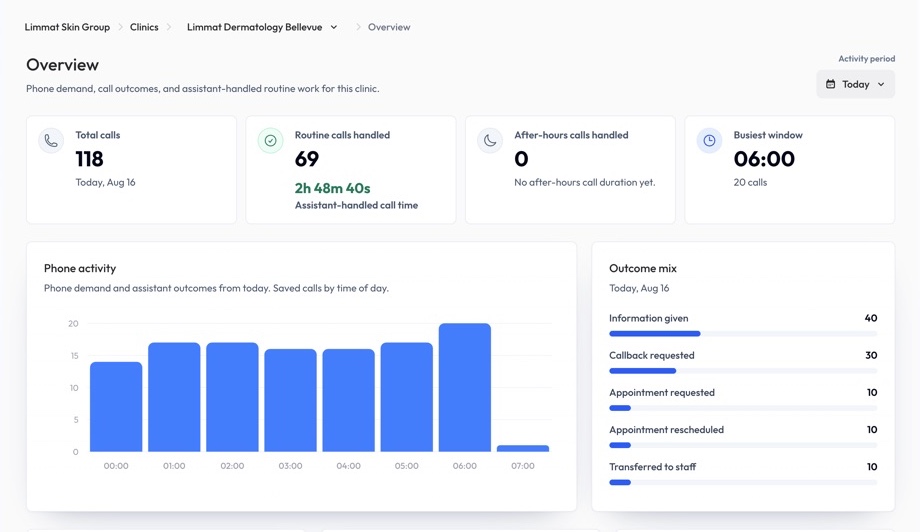
One ordinary week of call patterns shows where Vite Clinic can create the fastest relief. Keep the record operational and free of patient details.
- Count calls by half-hour so peaks, lunch breaks and closing periods are visible.
- Record the reason in a short category such as appointment, opening hours, callback or medical question.
- Mark whether the call was completed, transferred, missed or repeated.
- Note a simple duration band instead of recording conversation content.
- Remove names, phone numbers, health details and any other patient identifiers.
Buyer check
Use the phone-pressure worksheet
Download the worksheet and record one line for each half-hour or other fixed time block during one ordinary week. This gives the clinic a baseline before the phone path changes.
Keep patient details out
Record counts only. Do not enter names, phone numbers, birth dates, health details, call notes, or free text.
The worksheet tracks
- Date
- Time block
- Calls received
- Calls unanswered
- Repeat calls reported
- Routine requests
- Appointments booked
- Staff minutes
Open it in Excel, Numbers, or another spreadsheet app. The file stays on your device unless you choose to share it.
After one week
- Add calls received and unanswered to see demand and leakage.
- Compare repeat calls with routine requests to spot avoidable follow-up.
- Add staff minutes to estimate the weekly interruption load.
- Keep the completed sheet as the baseline for a Vite Clinic pilot.
Sort the work
Separate predictable administrative work from calls that need a person. The clinic decides the boundary.
Let Vite Clinic handle
- Opening hours, directions and approved service information.
- Appointment requests, changes or cancellations when the workflow is defined.
- Callback requests with the details the clinic has approved.
- Language selection and other predictable administrative questions.
Keep a person in the path
- Medical, urgent or safety-sensitive questions.
- Results, surgery, medication changes or other private clinical discussions.
- Unclear identity, consent or instructions.
- Distress, complex circumstances or any caller who asks for a person.
Pilot plan
Take pressure off
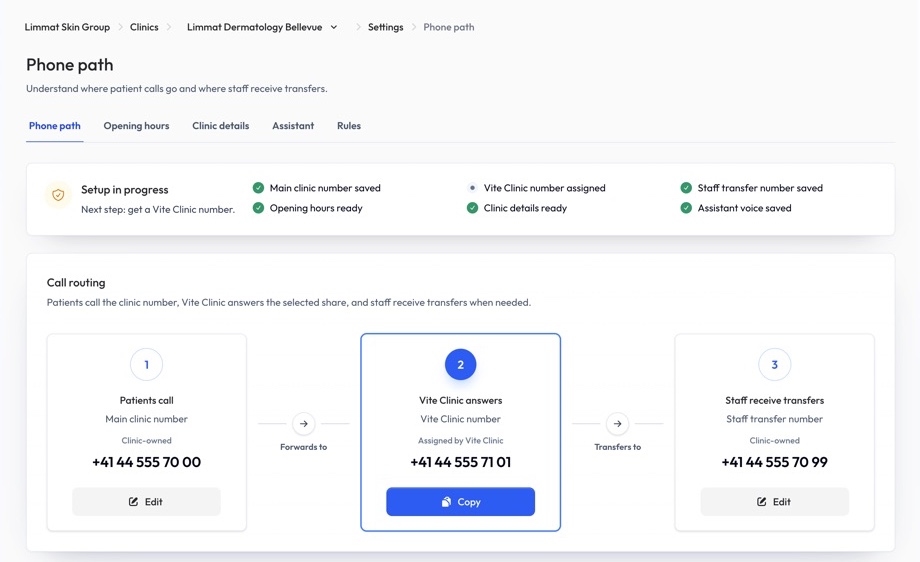
Keep your current number. Onboarding defines the first time window, PMS actions, human path, owners, and success measures before live calls.
- Agree the onboarding scope, first time window, owners, and success measures.
- Write the human transfer and no-answer path before the first real caller.
- Keep the current phone number and use controlled forwarding.
- Test clinic-approved information with synthetic scenarios in every needed language.
- Change how much forwarded traffic Vite Clinic answers at any time.
Measure the change
Measure the outcomes that matter: fewer interruptions, more completed requests, more booked appointments, and the revenue they help create.
- Calls offered, completed, transferred, missed and repeated.
- Routine requests completed without a second patient call.
- Transfers that reached the right person or followed the approved no-answer path.
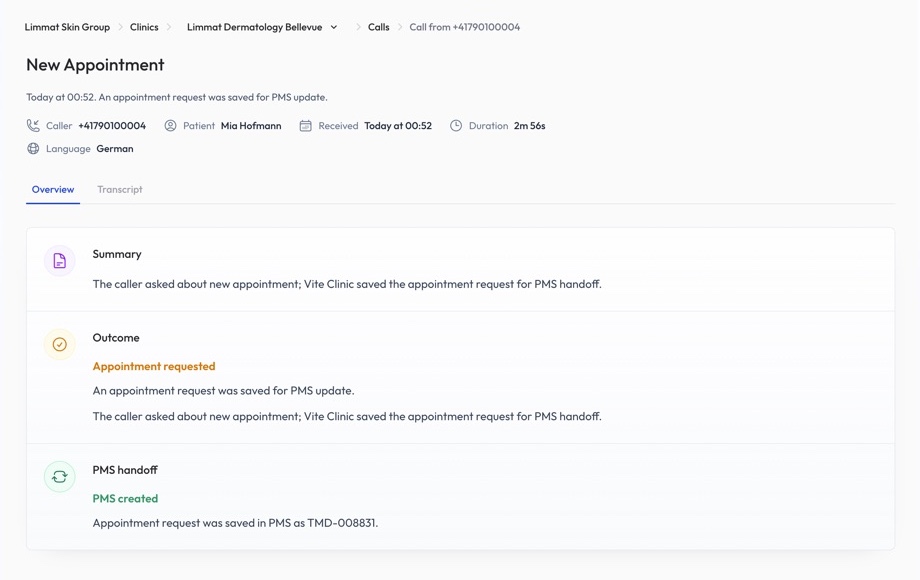
- Appointments, callbacks and follow-up that reached the intended clinic workflow.
- Medical practice assistant feedback on interruptions, clarity and new work created.
Keep the human path
Vite Clinic handles predictable administrative work and keeps a person in the path for medical, urgent, sensitive, or unclear calls.
- Medical, urgent, and sensitive questions go to the clinic team.
- Any caller can ask for a person.
- The clinic controls the transfer path and what happens when staff cannot answer.
Sources and limits
These sources document workload and administrative pressure in Swiss clinics. Each clinic’s result depends on its call mix and workflow.
- Medinside coverage of the MPAK Barometer
- FMH medical-practice-assistant role
- Obsan/BAG IHP 2025 report
Sources last checked: 14 July 2026
Take pressure off your front desk
Put Vite Clinic on your busiest phone hours.
Bring your call peaks, routine requests, human fallback, and PMS name. We will plan onboarding and a supported pilot across 30 live operating days around your real workflow.